Heroes of Hauling Characters: All Six Classes Explained
The North world's six adventurers run a moving company. Here are the official class details, the ability mappings that are still guesses, and the Bard's lute.
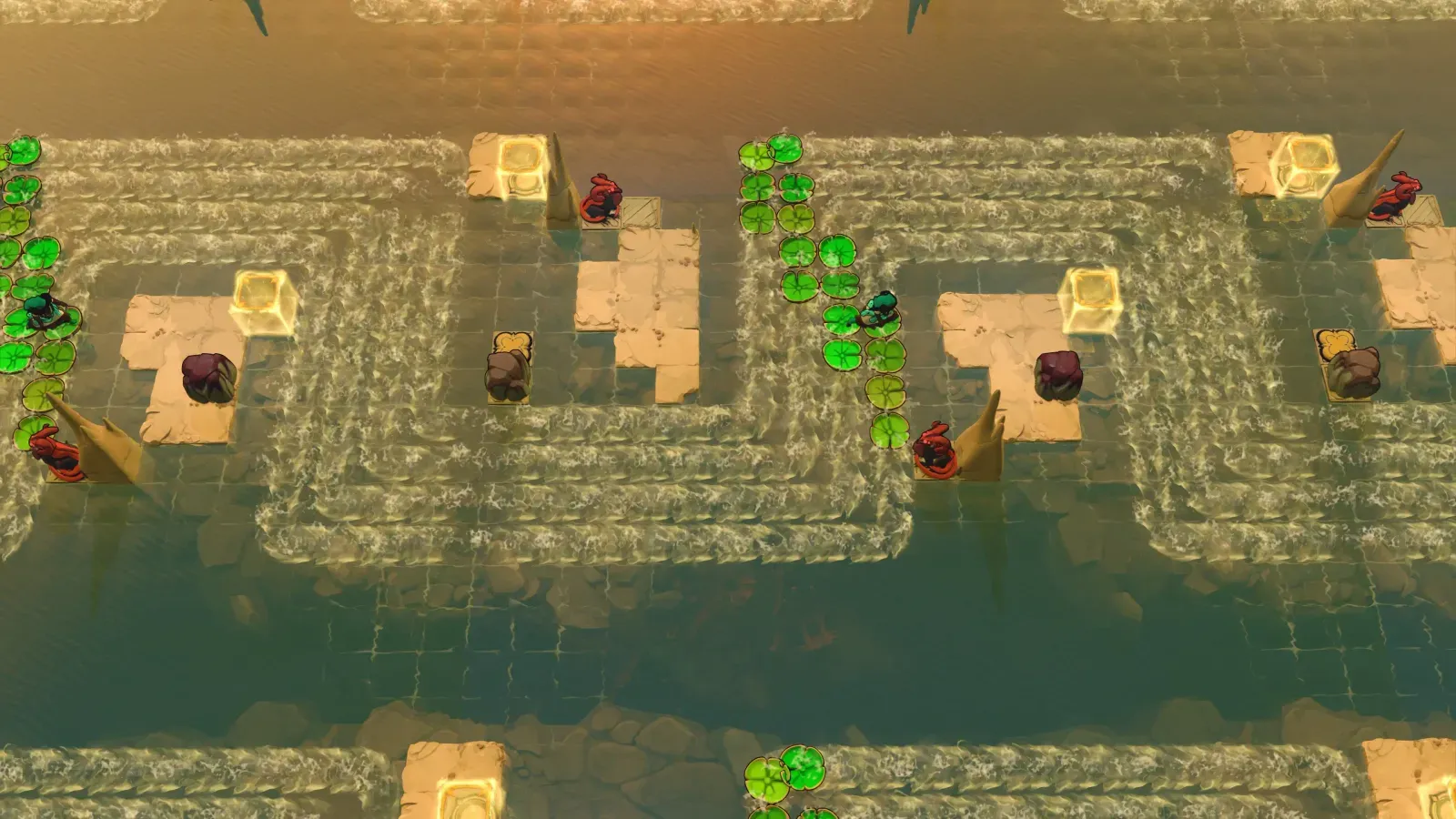
FAQ
What are the six Heroes of Hauling classes?
Which ability does each Hero of Hauling have?
Why does the Bard matter so much in the audio design?
Where did the Heroes of Hauling come from?
Can I play all six heroes in the demo?
Quick Answer
The Heroes of Hauling are the six-strong adventuring party of the North world: Warrior, Thief, Wizard, Bard, Cleric and Druid. They run a local moving company, and the developers describe using the party like a Swiss Army Knife, with individual characters pushing, pulling, teleporting past blockades and manipulating objects. Those class names and those action categories are official. The mapping between them is not. No source published before September 24, 2026 says which class does which.
This page separates the two on purpose. Getting excited about a class is fine. Treating a guess as a fact is how you end up stuck in a room built on the opposite assumption.
The documented roster
| Class | Officially named | Ability officially mapped to them |
|---|---|---|
| Warrior | Yes | No |
| Thief | Yes | No |
| Wizard | Yes | No |
| Bard | Yes (plus detailed audio documentation) | No |
| Cleric | Yes | No |
| Druid | Yes | No |
Six classes, six confirmed names, zero confirmed abilities. That is the honest state of the record.
Official source: New Trailer - Explore the Realm (Steam news, September 23, 2026)
What the developers actually describe
Instead of a kit per class, the official material describes a vocabulary of actions the party as a whole performs, and then says the interesting part is combining them.
| Documented action category | Confirmed as a game action | Confirmed owner |
|---|---|---|
| Pushing objects out of the way | Yes | No |
| Pulling objects into new positions | Yes | No |
| Teleporting past blockades | Yes | No |
| Object manipulation generally | Yes | No |
| Multi-hero chain reactions | Yes | Not a single class by definition |
| One class, one ability | Not stated | Not stated |
The developers’ own framing is that knowing what each ability does is the easy half. The hard half is understanding how different actions chain into multi-hero reactions, where one character’s move changes what the next character can do. That is a statement about the puzzle design, and it applies regardless of which class ends up owning which verb.
[!warning] Do not trust a tidy ability table A six-row table assigning one clean ability to each class is exactly the shape a speculative article takes. It is also exactly what the sources do not provide. If a page presents that table without hedging, it is inventing.
What each class usually does in this style of game
Everything in this section is expectation, drawn from how class-based puzzle games in the Sokoban lineage generally work and from the documented action list above. None of it is a statement about Order of the Sinking Star. Each entry separates what is documented about the class from what the archetype usually implies.
Warrior
Documented: the class name, and a signature sound. The audio post says the Warrior’s leather cuirass creaks when you switch to him.
Archetype expectation: in class-based puzzle games, a heavy class usually exists to move what nobody else can. That tends to mean pushing mass, holding a position, or being the body that satisfies a weight-sensitive piece of the room.
What to watch for: whether any block resists a normal push, whether a push has a direction that matters, and whether a hero can anchor a mechanism while another hero works around them.
Not documented: any ability, any interaction rule, any stat.
Thief
Documented: the class name, and a signature sound. The Thief’s bag beads rattle when you switch to him.
Archetype expectation: a thief archetype usually owns access rather than force. In puzzle terms that is often reaching through a gap, taking or moving an object another class cannot handle, or getting to a position without disturbing the room.
What to watch for: whether a character can carry something, whether carrying changes movement, and whether a small gap in a wall is decoration or a route.
Not documented: any ability. Note that “teleporting past blockades” is a documented party action, but the sources do not say the Thief is the one doing it.
Wizard
Documented: the class name only. No signature sound detail was published for the Wizard in the audio post.
Archetype expectation: of the six, the Wizard sits closest to the action category “teleporting past blockades”, which is why so many previews guess the Wizard is the teleporter. That guess is reasonable and still a guess. Mages in this lineage are usually the class that bends spatial rules rather than moving mass.
What to watch for: whether a teleport needs line of sight or an anchor, whether it moves the hero, an object, or both, and whether swapping positions is distinct from teleporting.
Not documented: any ability, and whether the Wizard’s toolkit overlaps the world mechanics of another region.
Bard
The Bard is the one member of the party with substantial published technical detail, and almost all of it is about sound rather than puzzle logic.
In 2022, the audio team built an in-game lute sample instrument from scratch with lute player Fredrik Bock. Every note variant was recorded: plucked strings, open strings, vibrato and chords. The total is 1300 individual sound files, and they are triggered note by note at runtime according to gameplay and musical context. The practical result is that the Bard can start and stop playing naturally and run alongside the soundtrack without an awkward crossfade.
That is a remarkable amount of work for a character in a puzzle game, and it tells you the Bard is meant to be heard continuously rather than as a one-off effect.
Archetype expectation: a musical class in a puzzle game usually functions as support or tempo, changing the state of other pieces rather than moving itself.
What to watch for: whether music has any mechanical effect at all. The sources document the instrument thoroughly and say nothing about the lute changing a puzzle.
[!note] The 1300 files are real, the ability is not The lute detail is documented and specific. The Bard’s puzzle ability is neither. Do not let the quality of the audio documentation raise your confidence in a guessed mechanic.
Cleric
Documented: the class name only.
Archetype expectation: a cleric archetype usually restores or protects. In puzzle terms that often becomes undoing state, re-enabling a broken piece, or allowing a mistake to be survived.
What to watch for: whether an undo or reset is a character ability or a global game feature. In most puzzle games it is global, and assuming otherwise is a common early error.
Not documented: any ability.
Druid
Documented: the class name only.
Archetype expectation: a druid archetype usually deals in terrain. That implies creating, converting or growing the ground itself, which in a grid puzzle is a large and unusual power.
What to watch for: whether a terrain change persists after you leave the room, and whether it can be used to make a route that the level design otherwise forbids.
Not documented: any ability.
The real skill is chaining, not knowing
The developers’ stated focus is combining actions rather than memorising them. That has a practical consequence for how to play a party-based puzzle game: you are not looking for the strongest character, you are looking for the order.
The general shape of these solutions is that a room is solved by making a sequence of small state changes, where each character can only act usefully after the previous one has finished. If a move does not change anything another character can do, it is usually a step in the wrong direction. The official framing of the party as a Swiss Army Knife points the same way: the tool you need is defined by the situation, not by a fixed ranking.
That advice is deliberately generic. No official source has published a solution shape for a specific North world puzzle, and this site does not publish step-by-step solutions that were never confirmed. If you are stuck, the stuck puzzle checklist covers how to test your assumptions before you go looking for a walkthrough.
The design foundation behind the world
The North world is built on Heroes of Sokoban by Jonah Ostroff. The official FAQ lists the series, Heroes of Sokoban 1, 2 and 3, and describes it as “a fantasy-themed puzzle game where you manage distinct hero classes (like warriors and mages) with unique movement and pushing mechanics to reach the exit.”
That description is worth reading twice, because it describes the same shape as the party here: multiple classes, individual movement rules, and pushing as the core verb. It also explains why the North world is the most Sokoban-flavoured of the four.
One caveat. The official material does not state a one-to-one mapping between the four foundation games and the four worlds. The correspondence between Heroes of Sokoban and the North world, between Mirror Isles and the East, between Promesst and the West, and between Skipping Stones to Lonely Homes and the South is a reasonable reading of the themes, not a confirmed conversion. Treat it as a design lineage.
The wider design story is that the director, Jonathan Blow, deliberately avoided building the game around one central mechanic. Instead he describes assembling a kind of game design supercollider, colliding the ideas of several puzzle designers to produce a combinatorial explosion of possibilities. Those contributions include Zach Polansky, Patrick Traynor and Marc ten Bosch alongside the four foundation works.
The world they belong to
The party is the cast of the North world, which you can read about in the Heroes of Hauling walkthrough. Their world is one of four that start isolated, and their story only intersects the others when the realms are bridged, which the Gold Rooms page explains.
The documented clash partners matter here. The developers have named two pairings for the six bridging areas: the Explorer’s light beams with the Trader’s mirrors, and the moving crew with the Castaway’s skipping stones. The second pairing is the only officially named collision involving this party, and it is with the Castaway rather than with the Trader.
What is still not documented
- Any per-class ability, ability name, or ability description
- Any stat, cooldown or range for any hero
- Whether all six are playable at once, or whether you control one at a time
- Whether the party members are individually playable in the demo
- Who voices any of them; the cast has only been described as an “all-star ensemble”
- Whether the Bard’s music has a mechanical effect
Not confirmed as of September 24, 2026. This page is re-checked at launch on October 8, when the full class kits will be observable in game.
Related
- The Queen — the character the story follows across every world
- The Trader — the Mirror Isles protagonist
- The Explorer and the Castaway — the West and South leads
- Heroes of Hauling walkthrough — the North world itself
- Gold Rooms explained — where the party meets another cast
Related Articles
characters
The Explorer and the Castaway: OSS Heroes and the Talking Boat
The Explorer, the Castaway and the talking boat are three of the heroes in Order of the Sinking Star. Here is what the official material confirms about each.
characters
The Queen in Order of the Sinking Star: Story Role Explained
The Queen is the playable hero the Steam store names first and the closest thing Order of the Sinking Star has to a through-line. Here is what the devs confirm.
characters
The Trader: Order of the Sinking Star's Mirror Isles Hero
The Trader is the Mirror Isles protagonist: a wealthy merchant whose magic mirrors swap him and objects with their reflections. Here is what the devs confirm.
Was this helpful?
Thanks for the feedback!