Mirror and Reflection Mechanic: How Mirror Isles Works
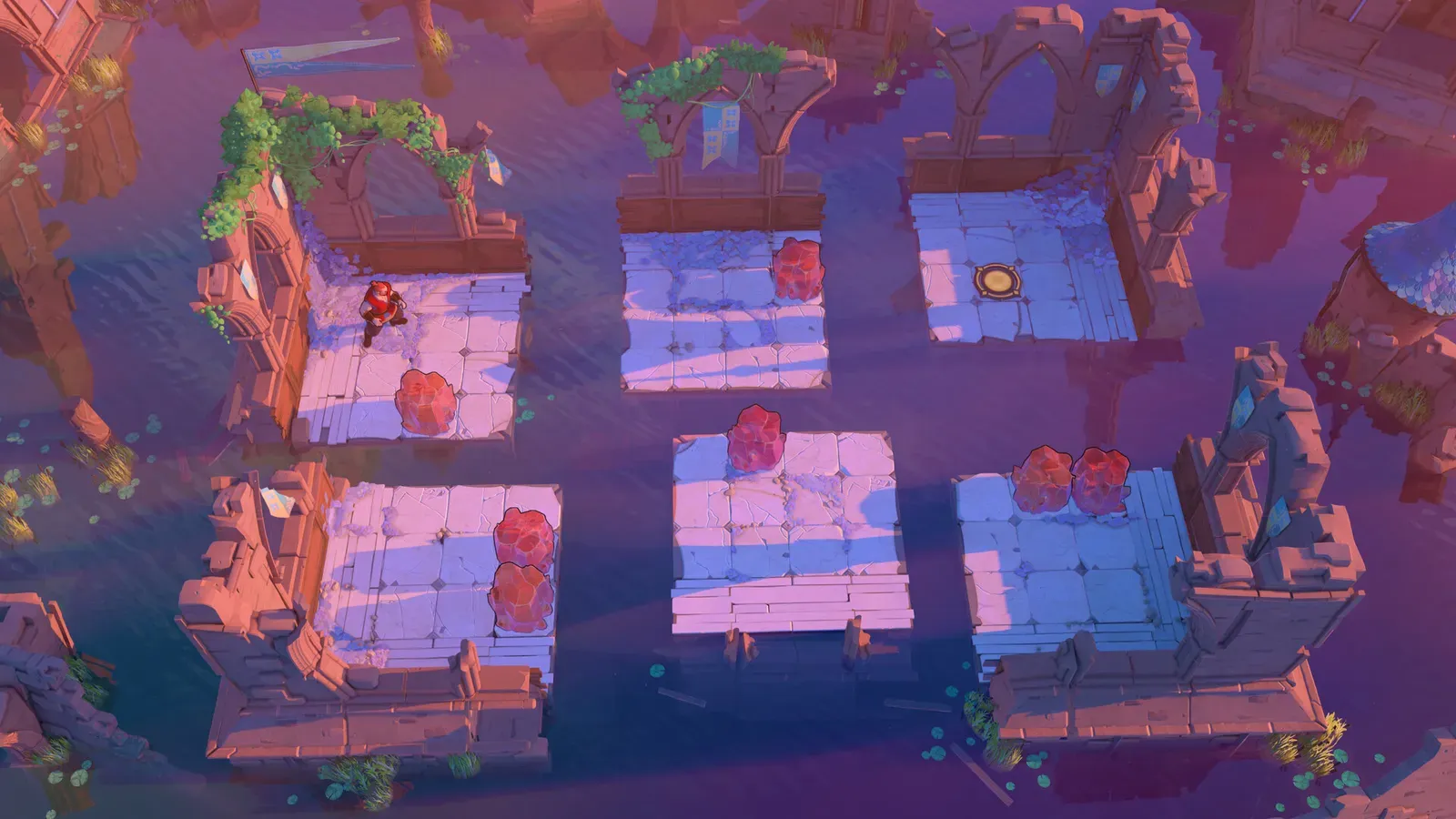
The Mirror Isles reflection is an active tool, not a copy. How swapping places with it, projecting it across water and stacking mirrors changes what you solve for.
FAQ
How does the mirror reflection work in Order of the Sinking Star?
Why does stepping back from a mirror let the reflection reach further?
What happens when there is more than one mirror?
Is the reflection a decoy or a second life?
Is Mirror Isles in the demo?
Mirror Isles looks like a puzzle about walking around an archipelago. It is not. It is a puzzle about owning two positions at once and deciding which one you want to be standing in.
Quick Answer
The reflection in Mirror Isles is a tool you deploy, not a copy that trails you. Everything the mechanic does comes from one verb: swapping places. You swap with your own reflection, and movable objects swap with theirs. Line up a mirror to project the reflection across water onto a distant island, step back from the mirror to buy that projection more distance, and remember that every extra mirror adds another reflection that also moves whenever you do. Solve for positions, not paths.
The reflection is a tool, not a copy
The developers keep returning to one distinction when they describe this world: the reflection is an active tool, not a passive copy. That single sentence does most of the work, because the two readings lead to completely different play.
A passive copy is a follower. If you believe the reflection mimics you, your instinct is to walk somewhere and check whether it kept up. A tool is something you aim. If you believe the reflection is a tool, your instinct is to ask where the reflection needs to be standing, then find the mirror alignment that puts it there. The second question is the one the puzzles are actually asking.
The practical consequence is that you should stop narrating the world as movement and start narrating it as placement. The Trader is not exploring. The Trader is arranging two bodies on a grid, one of which can be sent where no boat reaches. The east world is built on a wealthy Trader sailing a primal archipelago, and the magic mirrors are what turn that archipelago into a puzzle board rather than a map.
Official source: Order of the Sinking Star on Steam
What each piece of the mechanic is for
Before touching a puzzle, it helps to separate the vocabulary. These are the distinct things on a mirror board, and they behave differently enough that mixing them up is the most common source of a dead end.
| Piece | What it is | What it changes | What to plan for |
|---|---|---|---|
| The mirror | A fixed or re-aimable surface that defines where the reflection appears | Nothing on its own | Which direction it faces, and what the reflection line crosses |
| Your reflection | A second body occupying a real tile on the board | A second position you control | Where you want to end up, not where you currently are |
| An object’s reflection | A mirrored twin of a movable object | That object’s tile, once swapped | Whether the twin sits where the original needs to go |
| Water and open sea | The gap between islands that the reflection can be projected across | The reachable set of the reflection | Whether the projection lands on land or on water |
| Distance from the mirror | How far you stand from the surface before the swap | The reflection’s offset on the far side | Stepping back when the target is too far to reach |
| A second mirror | An additional reflection pair | Every reflection’s position at once | Whether moving for one reflection breaks another |
Every row is a lever. Very few mirror puzzles need all six at once, and a board that feels impossible usually has an unused row rather than a missing trick.
Why stepping back from a mirror adds distance
The detail players repeat most often is the least obvious one: backing away from the mirror increases how far the reflection can reach. The developers name this directly, and it is worth internalising as geometry rather than as a hidden rule.
A reflection sits opposite you across the mirror’s plane. Stand close to the surface and the reflection sits close on the other side, near the mirror and therefore near any island the mirror is standing on. Step back and the reflection’s offset grows, which pushes it further across the water. The mirror is not a window into a fixed location; it is a lever whose length is your own distance from it.
That reframes a whole class of puzzle. If the far island is out of reach, the board may not be asking you to find another mirror. It may be asking you to find room to retreat.
[!tip] When a projection lands short, try retreating one tile at a time and watching where the reflection lands. Distance from the mirror is a dial, not a property of the mirror itself.
The mental model: solve for positions, not paths
Almost every beginner failure in this world comes from planning a route. Route thinking works in the other three worlds, where a character walks from A to B and the terrain is the constraint. In Mirror Isles, the constraint is not the terrain. The constraint is that you only ever occupy two tiles at once, and the puzzle is decided by where those two tiles end up.
A more reliable mental model is a placement problem. Ask what the finished board looks like, then work backwards. Which body needs to be on which tile at the end? Is that body the Trader or the reflection? If it is the reflection, which mirror creates it, and does the Trader have enough room to stand far enough away? If an object needs to move, does it move by being pushed like a normal object, or by swapping with its reflection?
That last question is the second half of the mechanic, and it is easy to forget. Objects have reflections too, and an object can swap places with its mirrored twin. A heavy crate that cannot be pushed through a wall may have a twin standing on the correct side already. The swap is not a movement rule bolted onto a walking game; it is the primary verb of the world, and it applies to more than the Trader.
[!note] The grid itself does not change in Mirror Isles. What changes is how many actors are standing on it. If you want the general reading skill that transfers to every world, start with how to read a puzzle grid and then come back here.
Several mirrors means several reflections, all moving at once
One mirror is a spatial puzzle with a single extra body. Two mirrors is a coordination problem. The developers point out that using several mirrors creates several reflections, and those reflections all move at the same time. There is no option to freeze one while you adjust another.
This is where the eastern world earns its reputation. Players consistently report that the toughest puzzles in the demo sit in the mirror section, and the reason is structural rather than sadistic: with two reflection lines live, a swap that fixes one body’s position necessarily changes every other body’s position relative to its own mirror. You are not solving two puzzles side by side. You are solving one puzzle whose degrees of freedom are coupled.
The workable approach is to identify the body that has the least freedom. If one reflection has only one valid destination tile, set it first and treat everything else as consequences. Boards with many mirrors usually have one position that is over-constrained, and that position is the thread to pull.
Common mis-readings of the mechanic
These are the interpretations players report getting stuck on, roughly in the order they cause trouble.
The first is treating the reflection as a follower. Players wait for it to move, assume it copies their last step, and then conclude the puzzle is broken. It does not copy. It moves when the board says it moves.
The second is treating the reflection as a decoy. If you assume its only purpose is to distract or to die in your place, you stop asking what its position could unlock, and you skip the entire class of puzzles where the answer is simply that the reflection should be standing somewhere you cannot reach.
The third is forgetting that mirrors can be aimed or repositioned. Treating a mirror as scenery removes the main lever on the board, and the puzzle stops having a solution.
The fourth is forgetting that objects reflect as well as people. Players who only ever swap themselves will stall the moment a crate has to cross a barrier.
The fifth is assuming that adding a mirror adds an independent puzzle. It does not. It adds a coupled one. If you are planning each reflection separately, you are planning wrong.
Where this mechanic goes later
Mirror Isles is a demo world, but the mechanic does not stay inside it. The Gold Rooms are where worlds are bridged, and one of the two combinations the developers have named publicly is the Explorer’s coloured light beams combined with the Trader’s magic mirrors. That pairing tells you what to expect: projection and combination locks layered on the same board, where a beam may decide which mirror alignments are even possible. Getting comfortable with position-swapping now is what makes that crossover readable rather than overwhelming.
For the world itself, the Mirror Isles walkthrough covers structure, pacing and the community hints for the notorious late puzzle. For the demo’s shape, see the demo length and puzzle count breakdown and the progress carry-over question if you are deciding whether to finish now.
Related
- Mirror Isles walkthrough — the eastern world in context
- Gold Rooms explained — where beams and mirrors end up on the same board
- How to read a puzzle grid — the reading skill underneath every mechanic
- Demo length and puzzle count — how much of this the demo actually contains
- Does demo progress carry over? — what happens to your mirror puzzle progress at launch
This page is re-checked at launch, when the full set of mirror interactions becomes verifiable in the released build.
Related Articles
characters
The Trader: Order of the Sinking Star's Mirror Isles Hero
The Trader is the Mirror Isles protagonist: a wealthy merchant whose magic mirrors swap him and objects with their reflections. Here is what the devs confirm.
puzzles
Gem Light Beams and Colour Abilities in The Promise
How giant gems and coloured light beams work in the western caves, the three abilities the developers name, and why the colour-to-power mapping is still unconfirmed.
puzzles
How to Read a Puzzle Grid in Order of the Sinking Star
A general-purpose method for reading grid puzzles in Order of the Sinking Star: separating interactive tiles from decoration, finding the goal, and counting moves.
Was this helpful?
Thanks for the feedback!