Gem Light Beams and Colour Abilities in The Promise
How giant gems and coloured light beams work in the western caves, the three abilities the developers name, and why the colour-to-power mapping is still unconfirmed.
FAQ
How do the light beams work in The Promise?
What abilities do the beams unlock?
Which colour gives which ability?
Why does a beam matter in a different room?
Is The Promise in the demo?
The western world is the most system-like of the four. Where the northern world asks you to sequence actions and the eastern world asks you to place two bodies, The Promise asks you to configure a network and then walk through it.
Quick Answer
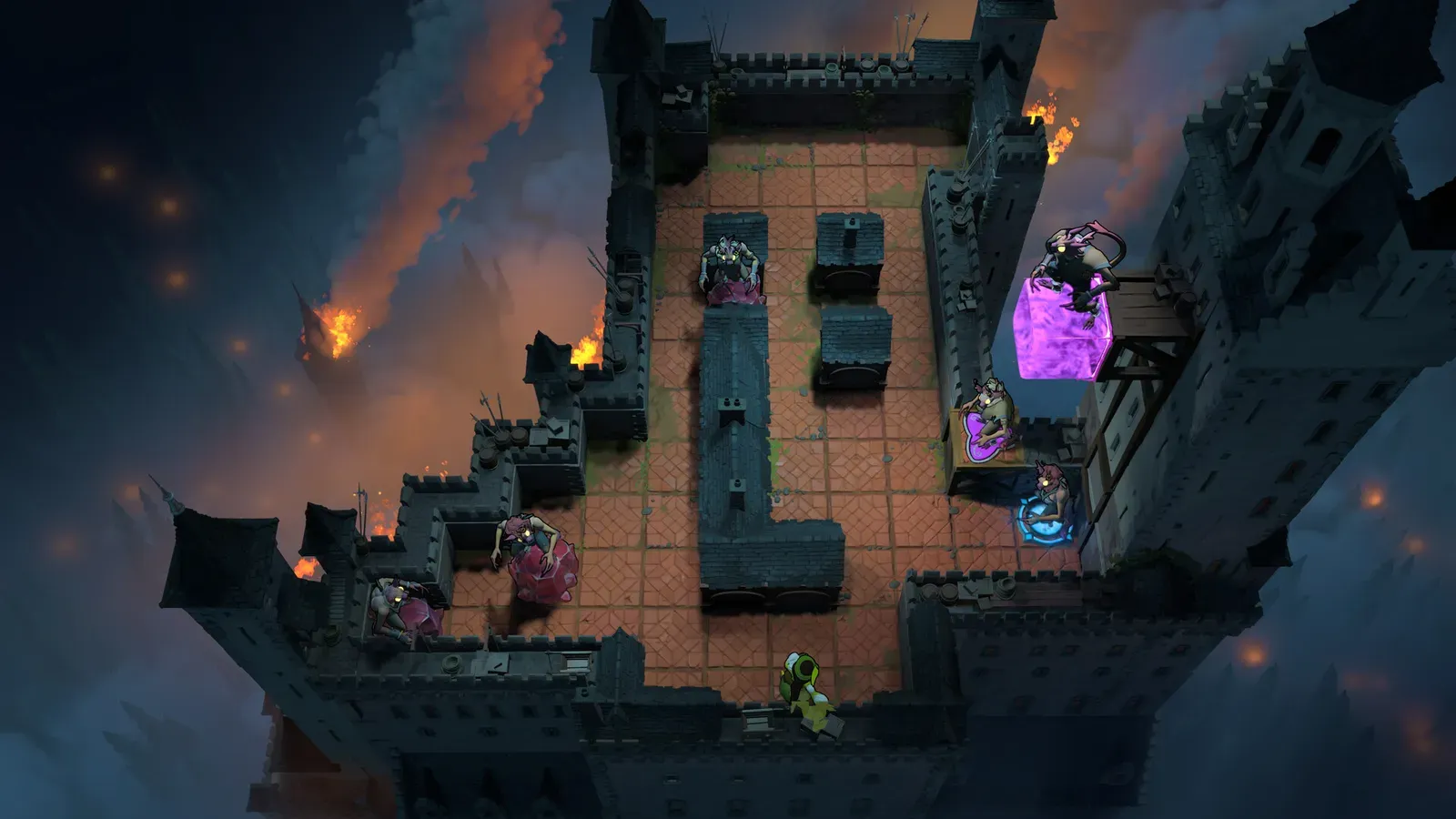
Giant gems channel coloured beams of light through the subterranean caves of The Promise, and those beams unlock dynamic abilities for the Explorer. The developers name three effects: phasing through solid walls, smashing boulders and long-distance teleports. Passage opens when the right combination of beams is lit at the same time, and the decisive move is often noticing how a colour lit in one chamber changes what is possible in a distant one.
What the gem and beam system is
The Promise is built around an Explorer heading alone into a vast network of subterranean caverns. Inside those caverns, giant gems channel coloured beams, and the beams are not decoration or lighting. They are the ability system. A lit beam grants the Explorer a capability that changes what a move can do, and the developers describe the abilities themselves as dynamic rather than permanent.
The important structural point is that the ability is not attached to the Explorer the way an unlock is attached to a character in most games. It is attached to the state of the light. If the combination falls apart, the capability goes with it. That is why the official description frames the puzzle as lighting the correct combination of beams simultaneously rather than as finding a key.
Official source: Order of the Sinking Star on Steam
The three abilities the developers name
Official material names three effects that the beams unlock. These three are the confirmed list, and they are worth separating because they do different kinds of work on a board.
| Named ability | What it does | What kind of problem it solves | What to check before relying on it |
|---|---|---|---|
| Phasing through solid walls | Lets the Explorer pass terrain that normally blocks movement | Access, not rearrangement | Whether the phase is one-way, and what waits on the far side |
| Smashing boulders | Removes a boulder obstacle | Permanent board change | Whether the boulder was also part of the solution, since removal cannot be undone |
| Long-distance teleport | Moves the Explorer across a large distance | Connecting two areas that are not adjacent | What the destination requires, and whether the beam state survives the trip |
Notice the pattern. Two of the three are about topology and one is about removal. Phasing and teleporting both answer the question “how do I get from here to there”. Smashing boulders answers “what is in the way”, and it is the only one of the three that writes to the board permanently. In a game where committed moves are expensive, the destructive ability is the one to hold back.
[!warning] Smashing is the only named ability that consumes a part of the board. Before using it, ask whether the boulder is an obstacle or a piece. If it is a piece, the beam combination is telling you to solve around it, not through it.
Why the puzzle is about combinations, not switches
The developers describe the core difficulty in a specific way: the correct combination of beams has to be lit simultaneously. That word, simultaneously, is the whole design. A room with three gems is not three rooms with one gem each. It is one state space in which each gem can be on or off, and only some of the resulting combinations open the way forward.
This is a familiar genre shape dressed in a new theme. Instead of a set of switches that must all be correct, the beams are powers that must all be present at once, and each one changes what the Explorer can physically do. The practical reading is that you should track state, not route. Write down which gems are currently lit and what each grant does before you start moving, because the abilities you are holding determine which moves are legal in the first place.
The reason this trips people up is that the ability changes the rules of movement, and players usually plan a route first and look for abilities second. In The Promise that order is backwards. The legal move set is a function of the light state, so the light state has to be planned before the route.
Distant effects: why a colour matters in another room
The second half of the developers’ description is the part that makes the western world unusual: the key is noticing how the colours open opportunities in distant environments. A beam you configure in one chamber can change reachability somewhere else in the cave network.
That means two things for how you plan. First, when you enter a chamber, ask what it changes elsewhere, not only what it unlocks locally. A gem that appears useless in the room you found it in may be the reason a corridor three chambers away is now passable. Second, the map is a connected system rather than a sequence of isolated rooms, which is consistent with the wider structure of the game: the Overworld is open from the start and the four routes interlink as the fog lifts.
The consequence for note-taking is real. In a system where effects propagate, the last thing you changed is often the thing that opened the path you already gave up on. Keeping a short list of unlit gems and unexplored dead ends pays off more here than in any other world.
[!tip] If a route refuses to open, retrace the last beam change you made rather than the last room you entered. In The Promise the cause is more likely to be a light state than a missed door.
The colour-to-ability mapping is still unconfirmed
There is a strong temptation to publish a tidy colour chart for this world, and it should be resisted. The only known claim comes from a single preview piece, CGMagazine, dated June 10, 2026, which reportedly stated that green handles phasing through walls, blue handles pushing boulders, and yellow does something the text does not finish describing. That is one truncated preview source, not a developer statement.
| Colour | Ability claimed | Source status |
|---|---|---|
| Green | Phasing through solid walls | Reported by one preview, June 10, 2026 |
| Blue | Smashing boulders | Reported by one preview, June 10, 2026 |
| Yellow | Not stated, the preview text is truncated | Unknown |
| Any other colour | Nothing published | Unknown |
What is officially confirmed is the list of three effects and the idea that the correct combination must be lit at once. What is not confirmed is which colour does which, whether colours are consistent across chambers, or how many colours exist. A chart is a reasonable thing to build in-game once the demo or the launch build makes it verifiable. Until then, treat any mapping as reported, and expect a single-source chart to be incomplete rather than wrong.
How to approach a western chamber
Four habits make this world manageable.
Read the room as a state machine. Identify every gem, note its current state, and list which granted abilities are live before you move.
Separate access from modification. Decide whether your problem is reachability or obstruction, because phasing and teleporting answer the first and smashing answers the second.
Check what the combination costs elsewhere. If three beams must be lit at once, ask whether lighting them leaves any of them unreachable, which is the classic failure mode of simultaneous-state puzzles.
Save the destructive move. Since smashing is the only permanent write to the board, treat it as the last resort that unlocks the rest.
The Promise walkthrough covers the world’s structure and pacing. The mechanic does not stay contained either: the developers name the Explorer’s coloured beams combined with the Trader’s magic mirrors as one of the two Gold Rooms pairings, which means light states and reflection alignments will eventually share a board.
Related
- The Promise walkthrough — the western world in context
- How to read a puzzle grid — the shared reading method for every mechanic
- Gold Rooms explained — where beams and mirrors are combined
- Demo length and puzzle count — what content the demo actually contains
- Does demo progress carry over? — what happens to your saves at launch
This page is re-checked at launch, when the colour-to-ability mapping can be verified in the released build.
Related Articles
characters
The Trader: Order of the Sinking Star's Mirror Isles Hero
The Trader is the Mirror Isles protagonist: a wealthy merchant whose magic mirrors swap him and objects with their reflections. Here is what the devs confirm.
puzzles
How to Read a Puzzle Grid in Order of the Sinking Star
A general-purpose method for reading grid puzzles in Order of the Sinking Star: separating interactive tiles from decoration, finding the goal, and counting moves.
puzzles
Mirror and Reflection Mechanic: How Mirror Isles Works
The Mirror Isles reflection is an active tool, not a copy. How swapping places with it, projecting it across water and stacking mirrors changes what you solve for.
Was this helpful?
Thanks for the feedback!