Push, Pull and Teleport Abilities: Hauling Actions
How pushing, pulling and teleporting change the grid in Heroes of Hauling, which actions move you and which move the board, and why chaining two heroes beats one.
FAQ
What actions do the Heroes of Hauling have?
Which action changes my position and which changes the board?
Why does the order of actions matter?
What is a multi-hero chain reaction?
Is there a class-by-class ability list?
The northern world is the most Sokoban-shaped part of Order of the Sinking Star, and it is where the game is most honest about being a grid puzzle. Nothing moves unless an action moves it, and every action leaves a mark on a board you can count.
Quick Answer
Heroes of Hauling runs on three named actions: push, pull and teleport. Push and pull change two things at once, because the object shifts and your hero takes a new tile. Teleport changes one thing, because only your position moves while the board stays as it was. Because every action writes to the same grid, the order you perform them in is a puzzle constraint rather than setup. Chain two heroes and you get effects neither can produce alone.
The three named actions
Official material for the northern world names pushing, pulling and teleporting past blockades as the action vocabulary of the fantasy moving company. Those three verbs are confirmed. What is not confirmed is a mapping from each of the six classes, Warrior, Thief, Wizard, Bard, Cleric and Druid, to a specific ability. The developers describe each class as having its own unique ability for manipulating objects or reaching an exit, and they describe the assembled party as a Swiss Army Knife. The detailed class roster is not published.
That distinction matters for how you read this page. Everything below is about the three shared action categories, which are documented. It is not a leaked ability list, and anything that looks like one should be treated as unverified.
Official source: Order of the Sinking Star on Steam
What each action does to the grid
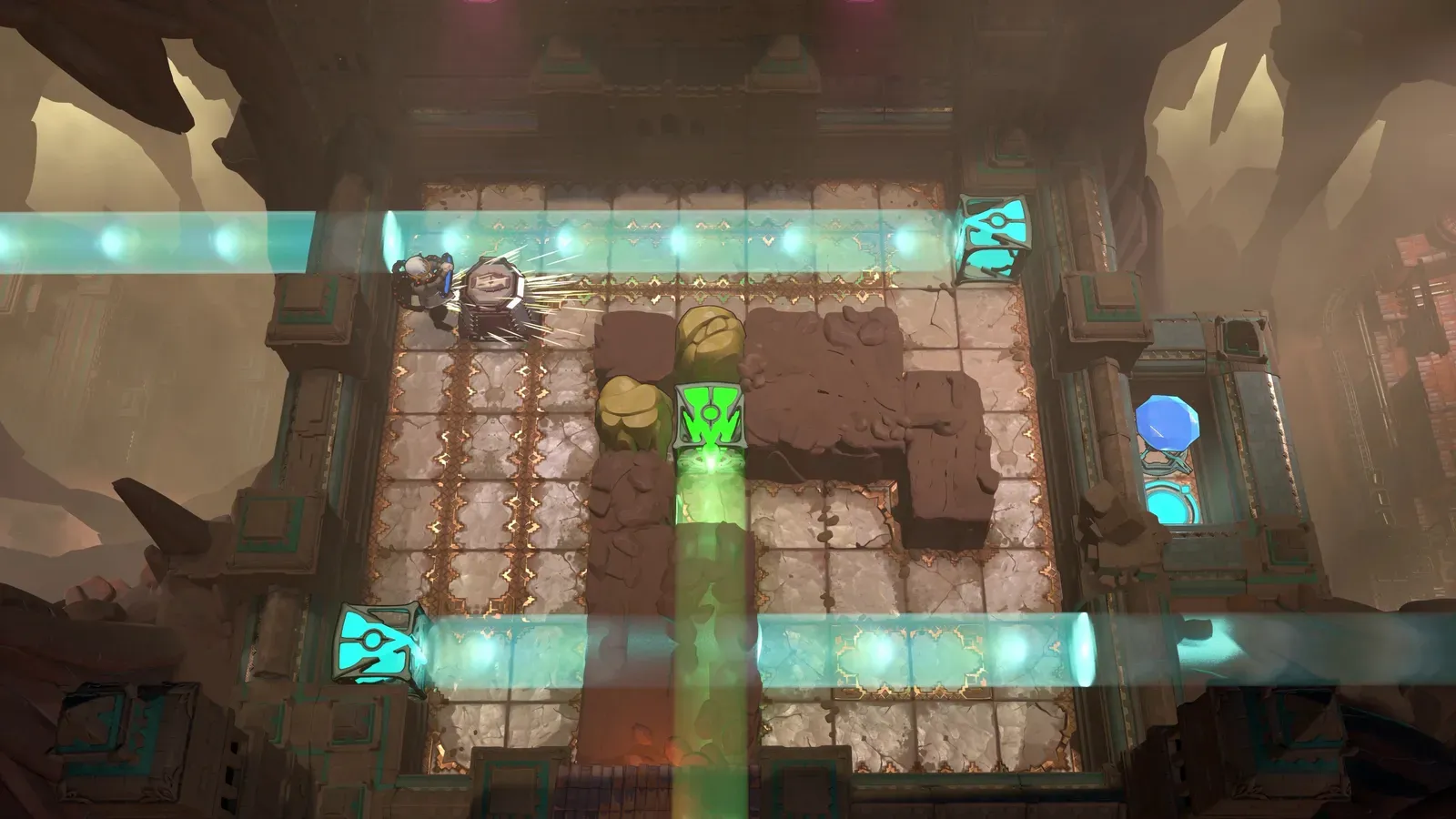
The cleanest way to plan in this world is to ask, for each action, two questions: which tiles change, and whose position changes. The table below separates them. The tile-level conventions are the standard Sokoban-family baseline that this world inherits, not a published rulesheet, so confirm the exact behaviour on a first easy board before you build a plan on it.
| Action | What changes on the grid | Whose position moves | Typical use |
|---|---|---|---|
| Push | A movable object shifts in the direction you face and you step into the tile it vacated | Both the object and the pushing hero | Clear a lane, seat a block into a gap, move a wall of objects one step at a time |
| Pull | A movable object is drawn toward you and you step back into the space it left | Both the object and the pulling hero | Reposition an object when there is no room to stand behind it for a push |
| Teleport | Nothing on the board changes; your hero’s tile is replaced by a target tile | Only the hero | Bypass a blockade, drop into an enclosed pocket, or reset position without undoing board state |
| Class-specific ability | Varies by hero | Usually the hero, sometimes an object | The situational tool that makes a plan work where the three shared actions cannot |
The third row is the one players underrate. Teleport is the only member of the core set that is board-neutral, which makes it the only action you can take without spending the board you have already arranged.
Which actions change you and which change the board
Push and pull are the same kind of operation. They are transactions between your hero and an object: you give up a tile, the object gives up a tile, and you effectively trade. Because both sides change, every push and pull is expensive. It consumes a free tile, it commits an object to a new square, and it may permanently close a lane behind it. In Sokoban lineage, a misplaced push is often unrecoverable, and this world is described as the most Sokoban-heavy of the four.
Teleport is a different kind of operation. It is a move that does not touch the board. That property makes teleporting the natural answer to two very different problems: getting past something you cannot move, and getting to a position the walking rules will not let you reach. The developers name it as the way to pass blockades, which is exactly what a board-neutral move is good for.
[!note] A useful habit: before any push, check whether teleporting would reach the same destination for free. If it would, you just saved a tile. Push and pull are for changing the board; teleport is for changing where you are.
Why order of operations is part of the puzzle
Every action writes to the shared grid, so actions interfere. A push that seats a block neatly into a wall gap may also seal the only corridor another hero needed. A pull may drag an object out of the lane that a later push was supposed to use. A teleport may place a hero on a tile that the party’s next move requires to be empty.
This is why order is not setup. In a game where the board only changes on committed moves, sequence is a resource. The same set of actions performed in a different order produces a different board, and only one of those boards may be solvable. Players who plan the destination but not the sequence end up with a correct idea and an unreachable state.
The practical routine: list the actions you intend to take, then check what each one consumes. Which free tiles does it use? Which lane does it close? Does any later step depend on the tile this step is about to change? If a step’s only purpose is to enable a later step, consider whether teleporting past it is cheaper than performing it.
[!warning] If a plan needs six free tiles and the board shows five, the plan is wrong. No amount of careful execution fixes a sequence that overdraws the space it has.
Chaining two heroes into an effect neither owns
The developers name multi-hero chain reactions as the real skill of this world, and they frame the party as a Swiss Army Knife. The point of that metaphor is that a tool kit is not a list of tools. It is a set of combinations.
A chain has a recognisable shape. One hero performs an action that changes the board in a way the second hero cannot produce by itself: pulling an object out of a corner so it can be pushed from a new angle, teleporting into a pocket to push from the far side of a blockade, or clearing a lane so a longer sequence becomes possible. The second hero then uses the changed board. Neither action is impressive alone. Together they reach a state the first hero could not walk into and the second could not create.
Three properties show up in almost every working chain.
The first is asymmetry. If both heroes can do the same thing, chaining them is just repetition. Chains matter when the two actions are different in kind, which is why the board-neutral teleport pairs so well with the board-changing push.
The second is a handoff tile. There is usually one specific tile that the first action frees or creates and the second action consumes. Identifying that tile is often the fastest way to spot the intended chain.
The third is reversibility. If a step cannot be undone, it belongs later in the sequence, after the reversible steps have been tested. Saving the committed push for last is a habit that costs nothing and prevents a large class of restarts.
Reading a northern board before you touch it
The northern world rewards a short pause at the start of each room, and the transferable skill is the same one that pays off in every other world. Count the movable objects and the fixed ones. Note which tiles are permanently occupied. Then decide what the room is trying to teach: a push lane, a pull angle, a teleport destination, or a chain between two heroes. The general method is laid out in how to read a puzzle grid, and it applies here with the extra twist that you have several bodies to place rather than one.
Once the chain habit clicks, this world stops being about strength and starts being about sequencing. The Heroes of Hauling walkthrough covers the world’s structure and pacing in more detail, and the Gold Rooms are where the party’s action vocabulary collides with the southern Sailor’s skipping stones.
Related
- Heroes of Hauling walkthrough — the northern world in context
- How to read a puzzle grid — the shared reading method behind every mechanic
- Gold Rooms explained — where the party gets combined with another world
- Demo length and puzzle count — how much of the northern world is playable now
- Does demo progress carry over? — what happens to cleared rooms at launch
This page is re-checked at launch, when the six classes and their abilities become verifiable in the released build.
Related Articles
characters
Heroes of Hauling Characters: All Six Classes Explained
The North world's six adventurers run a moving company. Here are the official class details, the ability mappings that are still guesses, and the Bard's lute.
characters
The Trader: Order of the Sinking Star's Mirror Isles Hero
The Trader is the Mirror Isles protagonist: a wealthy merchant whose magic mirrors swap him and objects with their reflections. Here is what the devs confirm.
puzzles
Gem Light Beams and Colour Abilities in The Promise
How giant gems and coloured light beams work in the western caves, the three abilities the developers name, and why the colour-to-power mapping is still unconfirmed.
Was this helpful?
Thanks for the feedback!