Order of the Sinking Star Stuck Puzzle Checklist
A spoiler-light routine for when you are stuck in Order of the Sinking Star: restate the win condition, sort movable from fixed tiles, and check reused mechanics.
FAQ
Is there a hint system in Order of the Sinking Star?
How do I know if a puzzle is impossible or if I am missing something?
Should I skip a puzzle I cannot solve in Order of the Sinking Star?
Do later puzzles reuse mechanics from earlier ones?
How long should I sit on one puzzle before moving on?
Being stuck in a grid puzzle is rarely about raw difficulty. It is usually one wrong assumption carried into a board that was designed to punish exactly that assumption. The fix is a routine, not a hint.
Quick Answer
Run six checks in order. Restate the win condition in one sentence. Sort every tile into movable, fixed or decorative. Ask whether a mechanic from an earlier puzzle is being reused here. Ask whether this board is teaching a new interaction rather than asking you to execute one you know. Count the moves you actually need. Then remember that you are allowed to leave — the Overworld lets you walk out of any world and come back.
[!note] This page deliberately contains no solutions. The point is to make your own reading of the board sharper, not to hand you a move order.
Why puzzles stall, and why it is usually not difficulty
Order of the Sinking Star was assembled from the ideas of several independent puzzle designers rather than around a single core mechanic. The developers describe the method as a game design supercollider: they took the foundations of four existing puzzle games by other designers, collided those ideas, and let the combinations multiply. Because the systems were designed to combine, the game can present a board that uses a rule you already learned, arranged in a way you have never seen.
Official source: Making of Order of the Sinking Star: the game design supercollider
That produces a specific kind of stall. It is not the stall of a board being too hard. It is the stall of a board being too familiar in the wrong way — you recognise the pieces, assume you know what they do, and start executing a plan that the level designer already accounted for. The diagnostic routine below exists to break that loop.
The diagnostic routine
Work down the table in order. Do not skip a row because it looks obvious; the first two rows catch the majority of genuine stalls.
| # | Check | How to run it | What it means if this fails |
|---|---|---|---|
| 1 | Restate the win condition | Say out loud, in one sentence, what the board wants: reach a tile, fill a shape, align a beam, deliver an object | You have been solving the wrong problem. Re-read the objective before touching anything else |
| 2 | Sort the tiles into movable, fixed and decorative | Point at each tile and classify it. Anything you are unsure about, test with a single cheap move | You are planning around a tile that does not behave the way you assumed. This is the single most common cause of a stall |
| 3 | Check for a reused mechanic | Name every mechanic this world has taught you so far, then ask which one this board is built from | You have not yet spotted the lesson the board is reusing. Walk back through the last few puzzles in your head |
| 4 | Ask whether this is a teaching puzzle | Is the board unusually small, unusually clean, or missing a piece you expected to have? | You are treating a tutorial as a test of execution. The board wants one new idea demonstrated, not a long plan |
| 5 | Count the moves | Work out the minimum moves the solution needs, then compare it with the free space the board gives you | The board is asking for a tighter route than you have been attempting, or a setup you have not built yet |
| 6 | Leave and come back | Retreat to the Overworld, cross into another world, or simply close the game | Nothing is wrong. Some boards read completely differently after a break, and the game is built to allow it |
[!tip] If two rows fail at once, the problem is almost always row 2. Tiles that look like scenery but move, and tiles that look movable but are fixed, defeat more plans than any other single mistake.
Check 1: restate the win condition
Grid puzzles hide their objective behind assumption more often than behind complexity. You may be trying to clear every tile when the board only asks you to reach one. You may assume the exit is wherever the light is brightest. Naming the goal in one plain sentence forces the assumption into the open, and it costs ten seconds.
A useful trick is to phrase the goal as a verb with a subject: deliver the crate to the marked tile; bring both heroes to the same side; route the beam into the receiver. If you cannot complete the sentence, that gap is the actual puzzle.
Check 2: catalogue movable versus fixed versus decorative
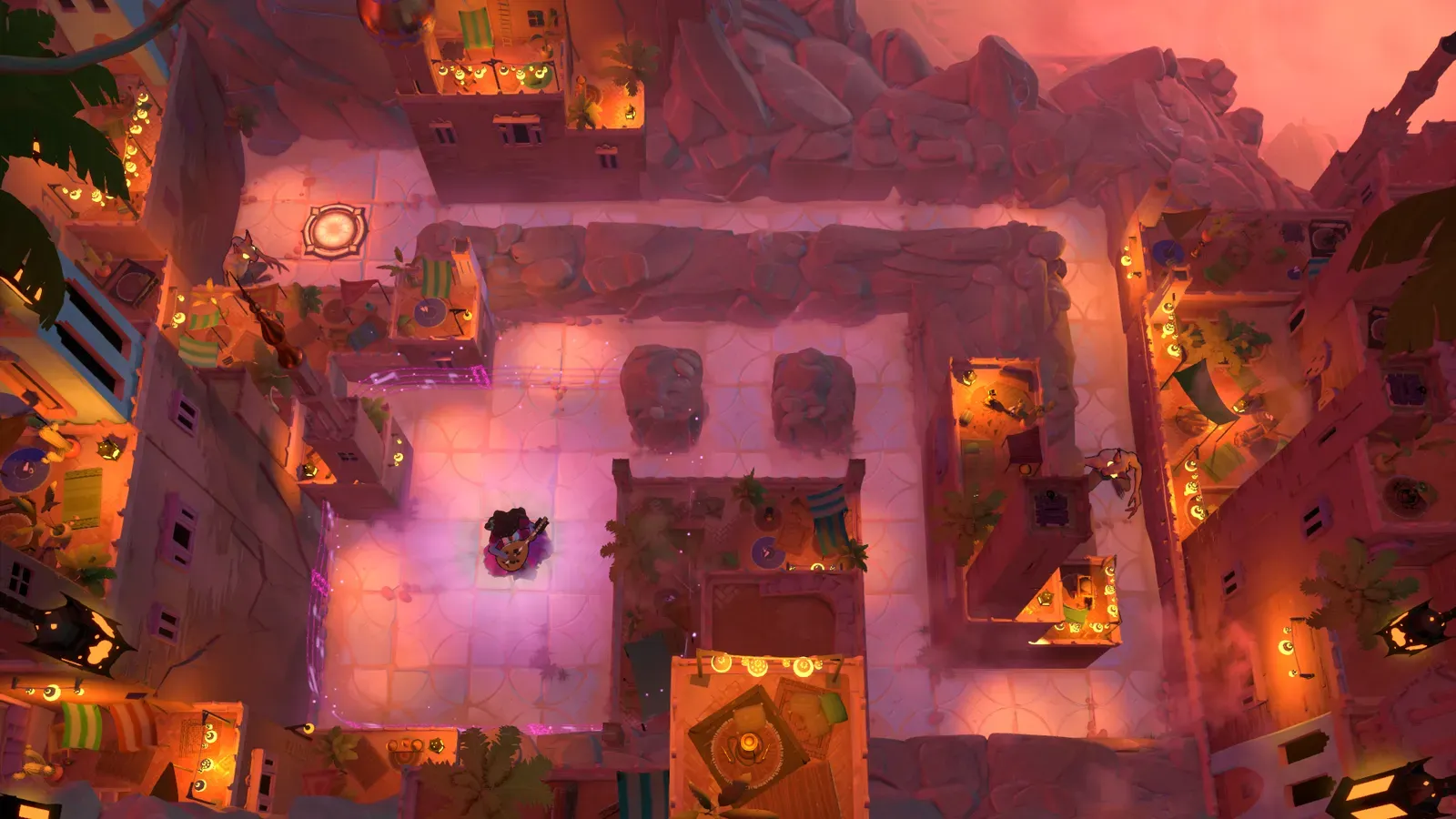
This is the highest-value check on the list, and it connects directly to how the game is drawn. The art team’s stated technique is to separate walkable space from background by brightness and by scale: walkable ground tends to read brighter, while background architecture is miniaturised so it does not look interactive. That means your eyes are being given a classification system — but the system is about walkability, not about which props can be pushed.
So catalogue separately. Three lists: what I can move, what never moves, and what does not matter. Then act on the third list only by ignoring it. If you find yourself planning around a prop you never actually tested, you have found your stall.
Check 3: look for a mechanic you already learned
The four worlds were designed to combine. When a new board feels unreadable, the odds are good that it is built from a verb you learned several puzzles ago and have since stopped thinking about. Name the world’s mechanics out loud in the order you met them. That list is short — this is a game of a few deep rules rather than many shallow ones.
If you are stuck inside the eastern world, the mechanic you have forgotten is likely to do with swapping positions with a reflection. If you are inside the northern world, it is likely a question of which hero can act on which side of a blockade, and in what order. The world-specific pages go deeper without giving away solutions: Mirror Isles and Heroes of Hauling.
Check 4: is this a teaching puzzle rather than a test?
Puzzle games usually introduce a new interaction in the smallest possible room, with the fewest possible pieces, before asking you to use it under pressure. If a board looks sparse, that sparseness is information. It means the intended solution is short.
The tell is asymmetry. A test of execution gives you roughly what the plan requires. A teaching puzzle gives you almost nothing and expects one specific move that demonstrates the new rule. When you catch that pattern, stop looking for the long solution and ask what single thing the board is trying to show you.
Check 5: count the moves
Because everything happens on a discrete grid, solutions are countable. Work out what the finish requires — how many objects must end up where, how many tiles must be freed — and compare the count with the space you have to manoeuvre. Grid mechanics punish wasted moves severely, since a single unnecessary push can seal a corridor permanently.
This is also the check that tells you whether you have a plan at all. If you cannot say how many moves the solution should take, you are exploring rather than solving, which is fine for a first pass and useless for the tenth.
Check 6: you are allowed to leave
The Overworld is fully open from the start of the game and the four routes branch in four directions, so retreat is always available. There is no penalty for leaving a puzzle unsolved, no resource you spend by walking away, and no order you are supposed to respect. When the worlds collide later in the game, the mechanics overlap, which means practice earned in one world continues to pay off in another.
If you want to know which route to walk to next, the Overworld map guide covers how the branches and the fog connect.
What not to do when stuck
Do not brute-force the board. A grid puzzle has a countable state space, but a large one, and random pushing tends to create a permanent dead end rather than information. If you must experiment, restart the puzzle first so the experiment is clean.
Do not assume the game is bugged. This is a hand-crafted puzzle game with a published count above one thousand, and the developers have described the systems as deliberately combinatorial. A board that seems to contradict itself is far more likely to be a rule you have not tested.
Do not grind through fatigue. The audio design is explicit about this. Music and ambience never loop and adapt to how long you have spent in a puzzle and how active you are, and there is a cool-down that fades the music when you stop moving. That fade is not a failure state; it is the game making room for you to think.
[!warning] Sound effects and character foley also grow lighter and simpler the longer you work on a hard puzzle, then recover their texture once you move again. If everything has gone quiet and flat, the design is telling you it is time for a break.
Related
- How to read a puzzle grid — the reading skill this checklist applies
- Beginner tips and first hour — what to do before you ever get stuck
- Overworld map guide — where to retreat to, and why
- The Promise walkthrough — the beam-and-gem world
- Demo walkthrough — what the demo includes before launch
This page is re-checked at launch, when the full puzzle set and any official hint features become verifiable.
Related Articles
guides
Is Order of the Sinking Star on Xbox? No, and Here Is Why
No. Order of the Sinking Star is not on Xbox or Game Pass, and there is no Switch 1, PS4 or Epic version either. It launches October 8, 2026 on PC, PS5 and Switch 2.
guides
Order of the Sinking Star Achievements Guide
Steam confirms Order of the Sinking Star has achievements, but no list is public before launch. What is confirmed, what is not, and what to expect on October 8.
guides
Order of the Sinking Star Beginner Tips: Your First Hour
What a new player needs in the first hour of Order of the Sinking Star: how the grid works, which world to start in, how to read the art, and how to avoid burnout.
Was this helpful?
Thanks for the feedback!