Skipping Stones and River Routing in the South World
How skipping stones, rideable lily pads and river redirection work in the southern world, why rerouting order is part of the puzzle, and how to plan reachability.
FAQ
How does the skipping stone mechanic work?
What makes a lily pad rideable?
How does redirecting a river change the puzzle?
Why does the order of rerouting matter?
Is the southern world in the demo?
The southern world is the calmest of the four and the most quietly demanding. It rarely punishes a wrong move immediately. It just leaves the Sailor standing on an island that is now unreachable, with no way back to the decision that caused it.
Quick Answer
Skipping Stones to Lonely Homes is a reachability problem dressed as open water. Huge skipping stones create stepping paths and land at specific points, rideable lily pads carry the stranded Sailor between islands, and redirecting a river rewrites what is reachable far downstream. The order in which you reroute the water is part of the puzzle rather than setup, because every change removes or creates the channels the next change depends on.
What the southern world actually is
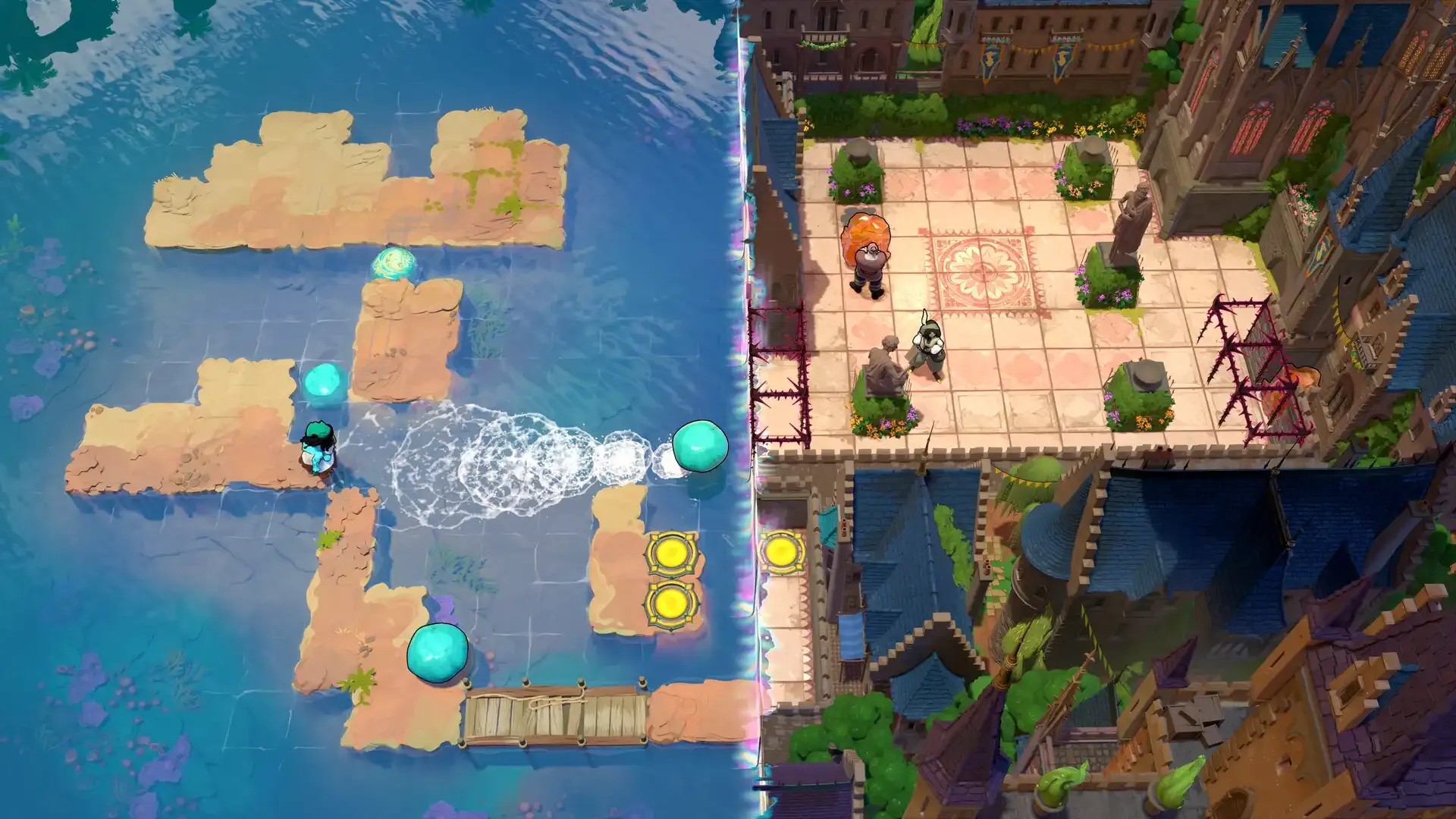
The world’s lead is a stranded Sailor, sometimes described as a castaway, moving from one island to the next across open waters. The mechanics are route planning, river redirection and stone-skipping logic. Those three are the documented backbone.
The world is also one of the four foundational design pieces the game is built on, and it inherits a direct lineage. The original is Alan Hazelden’s Skipping Stones to Lonely Homes, which the official FAQ describes in one line worth keeping in view the entire time you play this world: “A serene puzzle game about throwing stones into water to create stepping paths.”
That sentence is the mechanic. You are not crossing water. You are manufacturing the ground you will cross on, one landing point at a time.
Official source: Order of the Sinking Star on Steam
Note that the mapping between that original work and this world is a reasonable reading of the themes rather than a confirmed one-to-one statement from the developers, so treat the lineage as the world being built on that design rather than as an official proclamation.
The elements, and what each one controls
The fastest way to stop guessing in this world is to sort every object on the board into one of three columns: what it controls, what it constrains, and what it costs. The table below is the working vocabulary.
| Element | What it controls | What it constrains |
|---|---|---|
| Skipping stone | Where a stepping path can be created across open water | The number of hops available, and how many landing points you can afford |
| Landing point | Where a stone’s path terminates | Whether the far side is reachable on foot at all |
| Lily pad | A rideable platform for crossing water | Which direction the current carries it, and where it can be boarded |
| River channel | The direction water flows | Where anything floating downstream ends up |
| River redirection | The route the water takes | Reachability of every downstream tile, including ones you have not seen |
| The Sailor | The only body moving between islands | Cannot cross open water without a stone path or a pad |
| The order of rerouting | Which channel is changed first | Which downstream options still exist afterward |
Every entry in that table is a lever. A southern puzzle is almost never about a single element; it is about the interaction between a landing point you created and a channel you moved.
Where a stone can travel and where it lands
Stones in this world are not thrown at a target. They create a path, and the path has a terminus. The developers describe the intended analysis directly: work out where the huge skipping stones can travel, and mark the landing spots carefully.
The reason marking matter is that the landing point is the real decision, not the throw. Two throws that look similar can end on different ground, and only one of those grounds continues to the next island. A landing point on open water is a wasted stone. A landing point that connects to a dead-end beach is a stone spent on nothing. The stone is valuable because the number of hops is finite, which makes each throw a budget decision rather than a movement.
The second-order effect is that landing points compound. The first path is created on empty water with a wide choice of destinations. The second path starts from where the first landed, so its options are already narrowed. By the third stone you are usually working inside a corridor your own earlier decisions built. This is why southern puzzles reward planning the whole chain before the first throw rather than improvising.
What makes a lily pad rideable
The developers confirm that lily pads are rideable and that judging which direction to send a pad is a real part of the puzzle. They do not publish the exact qualifying conditions, so the practical approach is to check a short list of things in-game and build your own rule from what you observe.
[!note] The pad conditions below are the reasoning that follows from the official description, not a published rulesheet. Confirm them on a first easy pad before you plan around them.
The pad has to be on water you can reach, because a pad you cannot board is scenery. The water under it has to lead somewhere, because a pad on a closed channel is a dead end. The current has to move in a direction you want, or be redirectable into one. And the destination has to accept you, meaning there must be a place to step off rather than open water.
That last condition is the one players forget. A pad ride is only useful if it terminates somewhere the Sailor can stand, which is why pad routing and stone landings are the same puzzle rather than two parallel systems.
Rivers are a system, not scenery
River redirection is the mechanic that turns this world from a route puzzle into a reachability puzzle. When you change where a channel flows, you change what is downstream of it, and downstream reachability is exactly what a pad ride depends on.
The developers’ own framing points at this: after redirecting the waterways, you have to judge which direction to send the lily pads. That phrasing puts the redirection first and the pad second on purpose. The pad’s route is a consequence of the channel, so solving them in the opposite order means solving the wrong puzzle.
Two consequences follow.
The first is that the effect of a reroute is not local. It can open a route to an island you had written off, and it can strand a pad on a channel that no longer connects to anything. A reroute is a system-level edit.
The second is that some of what you change is invisible at the moment you change it. If a channel leads to a part of the map you have not sailed to yet, you are making a decision about a region you cannot see. That is the intended experience, not a design oversight.
[!warning] Before you reroute, check whether the change is reversible in practice rather than just in theory. A route back may exist on paper while costing more stones or a pad ride than you can still afford.
Why the order of rerouting is part of the puzzle
In a reachability system, order is not setup. It is a resource. Each reroute rewrites the board that the next reroute operates on, so a sequence of channel changes has to be planned as a sequence, not as a checklist.
The common failure looks like this. You reroute a channel to open a route toward an island you want, and in doing so you cut the flow that a pad elsewhere needed to reach a landing point you had already created. Every individual step was correct. The order was wrong. Because the change is downstream of a decision you have already made, the damage is often not visible until you arrive at the stranded location.
The workable discipline is to plan the reroutes backwards. Start from the destination island and ask which channel must be flowing in which direction for the final pad ride to work. Then ask which earlier reroute creates that state, and continue until you reach the channel you can change right now. Backwards planning is the natural fit for a world where effects propagate forward, and it converts an intimidating sequence into a chain of single requirements.
Reachability planning, step by step
A repeatable routine for any southern board: identify the destination and what counts as arrival. Identify which pad or stone path must serve the final leg. Work backwards through the channels that must be in a given state for that leg to exist. Check each planned reroute for what it removes as well as what it creates. Then spend your stones in the order that preserves the most options, saving irreversible changes for last.
The wider habit underneath all of this is the one that carries across the whole game: read the board for what is fixed and what is a lever before you act, which is the method in how to read a puzzle grid. The Skipping Stones to Lonely Homes walkthrough covers the world’s structure and pacing. When the worlds merge, this mechanic meets the northern party directly: the developers name the hauling crew combined with the Sailor’s skipping stones as one of the two Gold Rooms pairings.
Related
- Skipping Stones to Lonely Homes walkthrough — the southern world in context
- How to read a puzzle grid — the shared reading method behind every mechanic
- Gold Rooms explained — where the Sailor is combined with the hauling crew
- Demo length and puzzle count — what the demo actually contains
- Does demo progress carry over? — what happens to your routes at launch
This page is re-checked at launch, when the pad and river rules become verifiable in the released build.
Related Articles
characters
The Trader: Order of the Sinking Star's Mirror Isles Hero
The Trader is the Mirror Isles protagonist: a wealthy merchant whose magic mirrors swap him and objects with their reflections. Here is what the devs confirm.
puzzles
Gem Light Beams and Colour Abilities in The Promise
How giant gems and coloured light beams work in the western caves, the three abilities the developers name, and why the colour-to-power mapping is still unconfirmed.
puzzles
How to Read a Puzzle Grid in Order of the Sinking Star
A general-purpose method for reading grid puzzles in Order of the Sinking Star: separating interactive tiles from decoration, finding the goal, and counting moves.
Was this helpful?
Thanks for the feedback!