Order of the Sinking Star Overworld Map Guide: The Realm
How the Order of the Sinking Star overworld map works: the central hub, the four cardinal paths, fog of war, and why the whole Realm is open from the start.
FAQ
Is the Order of the Sinking Star overworld linear?
What are the four paths on the overworld map?
Does the overworld map change as you play?
How much of the overworld is in the demo?
Quick Answer
The Overworld, called the Realm in-game, is the central hub of Order of the Sinking Star. Four routes branch off it to the north, east, west, and south, and each one leads to a complete world with its own protagonist, mechanics, and cast. The entire overworld is free to explore from your first minute, there is no single correct order, and the map clears its fog of war as you make progress.
What is the Overworld (the Realm)?
The Overworld is the connective tissue of the whole game. Thekla describes it as a central hub with four routes fanning out by compass direction, and the worlds themselves are introduced as four separate stories before anything merges. You are not walking a corridor between levels. You are walking a map that behaves like a map: it has a shape, it has a boundary, and the boundary moves.
The official framing is deliberately anthology-like at the start. The game opens like a collection of four independent worlds, and the structural shock comes later, when the Gold Rooms make those worlds collide. That means the overworld is doing two jobs at once. Early on it is a menu of directions. Later it becomes the space where the merger physically happens.
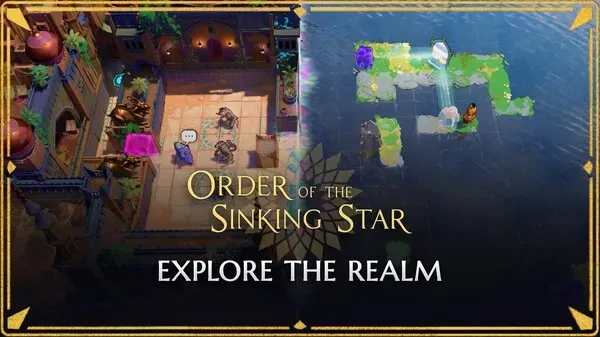
Official source: New Trailer - Explore the Realm
[!note] Everything in this guide describes structure and intent, not puzzle solutions. No official route list has been published. Where a claim comes from a player rather than Thekla, it is labelled as player-observed.
How the hub is laid out
The Realm has one large central hub with four routes extending north, east, west, and south. Each route carries a distinct theme, a distinct cast, and a distinct set of puzzle rules, so the direction you pick is also the mechanic you are signing up to learn.
Official source: Order of the Sinking Star news hub — Thekla describes the Overworld as “a sprawling central hub that offers total player freedom with no single ‘right way’ to proceed”, with the four paths branching out “across the cardinal directions”.
The four directions are not difficulty tiers. Thekla has said the whole overworld is open from the start, and press coverage of the September 23, 2026 trailer repeated that phrasing directly: how you reach any given area is up to you. What the directions really control is what kind of thinking you will be doing for the next stretch of hours.
| Direction | World | Protagonist | Core mechanic | Design lineage |
|---|---|---|---|---|
| North | The Hearty Heroes of Hauling | A moving company crew: Warrior, Thief, Wizard, Bard, Cleric, Druid | Pushing, pulling, and teleporting past blockades, combined into multi-hero chain reactions | Press-stated: Heroes of Sokoban 1, 2, and 3 by Jonah Ostroff |
| East | The Mirror Isles | A wealthy Trader sailing between islands | Swapping places with your own reflection, with objects, and with reflections of objects | Confirmed: Mirror Isles by Alan Hazelden |
| West | The Promise | A lone Explorer | Giant gems directing colored light beams that grant phasing, boulder-smashing, and long-distance teleportation | Press-indirect: Promesst 1-3 by Sean Barrett |
| South | Skipping Stones to Lonely Homes | A stranded Sailor, also referred to as the Castaway | Route planning, river redirection, skipping-stone landings, and lily-pad routing | Confirmed: Skipping Stones to Lonely Homes by Alan Hazelden |
[!warning] Thekla lists all four foundation titles but has not published a formal pairing chart. The confidence labels above come from press reporting, not official copy. South and East are the strongest mappings because the world names are identical to the source games. North is stated outright by press. West rests on Promesst’s own official description, “a cave filled with mysterious beams of light”, matching The Promise’s caverns and colored beams exactly. Patrick Traynor (Patrick’s Parabox), Marc ten Bosch (Miegakure), and Zach Polansky (Enigmash) are credited design contributors with no world attributed to them by any source, so do not attach them to a direction. All four foundation games were licensed with permission.
What each cardinal path leads to
North, The Hearty Heroes of Hauling. This is the most Sokoban-flavoured route. You manage six hero classes at once and the official emphasis is not on knowing what each ability does, but on understanding how the actions chain: push a block to clear a lane, pull an object out of the way, teleport past a blockade, and let a second hero finish a job the first one started. The official comparison is a Swiss Army Knife, which is a good description of how a puzzle expects you to swap tools rather than grind one.
East, The Mirror Isles. A single Trader with magic mirrors. Positions swap: the Trader and his reflection trade places, objects and their reflections trade places, and the official advice is to stop treating the reflection as a passive copy and start treating it as an active tool. You aim reflections at distant islands, and stepping backwards from a mirror buys you distance. It is the route that most players name when they talk about difficulty, and the Mirror Isles walkthrough covers why.
West, The Promise. An Explorer alone in vast subterranean cavern networks. Giant gems redirect colored light beams, and the beams unlock dynamic abilities, including phasing through solid walls, smashing boulders, and teleporting long distances. The official hint is to watch how beam colors open opportunities across a wide area, and to light the correct combination at the same time.
South, Skipping Stones to Lonely Homes. A stranded Sailor working between islands over open water. Route planning is the whole game here: you analyse where huge skipping stones will land, you redirect rivers, and you decide where a rideable lily pad should be sent once the water has changed course.
The four world walkthroughs are the right next stop once you have picked a direction: Heroes of Hauling, The Promise, and Skipping Stones.
Why there is no single correct order
Non-linearity here is a design decision, not a marketing line. Thekla’s own description states that the entire overworld is free to explore from the start, and press coverage from September 23, 2026 repeats it: there is no required order for tackling the four routes.
The practical consequence is that getting stuck stops being a wall. If a puzzle in the Mirror Isles refuses to click, you can walk away, go north, learn a different rule set, and come back with a fresh head. That is also the pattern The Witness veterans expect, and it is why the beginner tips page tells new players to change worlds instead of grinding.
A hands-on preview from the June 2026 demo adds one useful nuance: the reviewer reports that Blow suggested starting with the North or the East, describing them as the easier pair and a good way of settling in. That is a suggestion about where to begin, not a lock on where you are allowed to go.
Non-linearity is not formlessness, though. Blow has described the gating as curated rather than open: the team was careful about locking advanced ideas until players had done the earlier versions, so while you have a lot of freedom to explore, you also will not run into material you are not prepared for. In practice that means the map is open, but the map is also sequenced from behind.
[!tip] Treat the four directions as four teaching tracks. If one track’s rule set is not landing, that is a signal to walk to a different compass point, not a signal that you missed a step.
The overworld is a puzzle too
The Realm is not a menu you walk across to reach the actual game. Puzzles are entered through tiles on the floor of the overworld itself, and the map gates progress in the same way a level does. Once you have the basics down, the overworld introduces additional puzzle elements, so you have to solve puzzles there in order to reach new puzzle tiles. One press writer summarised the arrangement as puzzle-ception, which is a fair description of a map that behaves like a level.
Two structural details follow from that. First, opening new tiles is itself content, not traversal. Second, the map’s difficulty curve is part of the game’s difficulty curve, which is why the fog recedes in step with your understanding rather than with elapsed time.
Thekla also describes the game’s architecture as having three distinct sections across the map, with the final section being conceptually more experimental than the rest. Official art notes say that late section is visually marked by exposed grid cubes, and that the art there is deliberately more uncanny and surreal. That is a useful orientation cue: a shift in how the map looks is telling you where you are in the overall arc, not just decorating it.
Official source: Making of Order of the Sinking Star: Sights & Sounds of the Realm
What gates progress, and how heavily
There is one published description of the post-world progression structure, and it comes from a December 2025 preview rather than from the launch build. As described there, the four worlds amount to roughly the first five percent of the game. From that point the combination areas take over: they contain large star puzzles that fill a meter, filling that meter to 7 out of 10 opens a teleporter, four of the six teleporters are required to reach the endgame, and full completion asks for 10 out of 10 in all six.
[!warning] That progression model is December 2025 preview reporting, not confirmed launch structure. The build has changed since, and Thekla has not restated the numbers. Read it as the shape of the intended endgame rather than as a checklist you can plan around. This page is re-checked at launch.
The shape is still informative even with the caveat attached. It tells you the overworld is gated by a completion currency rather than by a key item, that the six combination areas are parallel objectives rather than a single linear path, and that finishing the story and finishing the game are deliberately separate bars. The portal stage is the direct consequence of the Gold Rooms, which is covered in Gold Rooms explained.
Fog of war, expansion, and backtracking
The overworld map is not fully drawn on day one in the sense that matters. Thekla says the map’s fog clears as you progress, revealing larger regions and increasingly interwoven mechanics. So the Realm literally grows as a function of what you have accomplished, and the growth is not only cosmetic: new mechanics arrive with the new space.
Backtracking is the mechanism that makes that growth usable. Areas you could not solve on the first pass become solvable once later tools exist, which means an early dead end is really a deferred task. The design leans on this hard enough that re-walking old ground is normal play, not a penalty.
Thekla frames the same idea as emergent crossover: abilities learned in one realm are suddenly shared with another, and characters from the North end up meeting characters from other locations. The map expansion and the mechanic expansion are the same event seen from two angles.
It also explains why the map eventually stops reading as four branches. Once the Gold Rooms change the structure, the four worlds stop being separate tracks and start colliding, and the map becomes a web of combination areas rather than a hub with four spokes. That shift is the subject of Gold Rooms explained.
How the map relates to the demo’s smaller slice
The demo is a selected portion of the full game. Thekla’s own wording is that it gives “a meaningful slice” of the more than one thousand puzzles, and the June 19, 2026 content update added new areas on top of the original slice. That makes the demo map a fragment of the Realm, not a miniature version of it.
What the demo does show honestly is the hub-and-spokes structure. The demo has a fast travel map of its own, and players report that it already carries overworld detail, including an audio log in The Promise area. Three routes have playable content: the North and the East as full routes, and the West, The Promise, as a single level rather than a region. The South, Skipping Stones to Lonely Homes, is not in the demo at all: IGN’s preview, The Gaming Outsider’s demo review and the creators.gg campaign brief each confirm that independently. A community map project tracked the demo as Phase 1 with 75 levels and Phase 2 with 105 levels as of June 19, 2026, which is a player count rather than an official one.
If you want the demo’s geography specifically, including the order in which its areas open, the demo map page handles that separately, because a demo slice and the full Realm are two different maps.
What is still unknown before launch
Being precise about the gaps matters more than sounding complete. As of September 24, 2026, the following are not published:
- How many discrete areas the full overworld contains.
- Whether the fog of war is purely visual, or whether it gates anything beyond the tile-level gating described above.
- Whether the December 2025 progression numbers survived into the launch build.
- How the map changes after each Gold Room, beyond the fact that two realms get bridged and six large dual-combination areas open up.
- How much of The Promise the demo’s single playable level represents.
- Which of the other credited contributors’ ideas landed in which world.
This page is re-checked at launch, when the full Realm is actually walkable.
Related
Related Articles
demo
Order of the Sinking Star Demo Map: Areas and Order
The Order of the Sinking Star demo map explained: which areas the demo covers, the order they open in, and how the community map fits in.
demo
Order of the Sinking Star Demo Secrets and Endpoint
What counts as hidden content in the Order of the Sinking Star demo, where the demo ends, and whether any demo-exclusive secret has actually been confirmed.
guides
Order of the Sinking Star Beginner Tips: Your First Hour
What a new player needs in the first hour of Order of the Sinking Star: how the grid works, which world to start in, how to read the art, and how to avoid burnout.
Was this helpful?
Thanks for the feedback!